


Learning to say no to too many activities, for yourself and your kids!
23 April, 2026
In today's society, a full schedule is often highly valued, and being busy is seen as a sign of success, good parenting and even a fulfilling life. And yet, many families find themselves out of breath, short on time and drained of energy, precisely because of their overloaded schedule. What if we learned to say no more often, for the well-being of parents and kids alike?
The overscheduling trap
The problem with overscheduling is that it rarely sets in all at once. An activity added here, a commitment made there, a request we say yes to because we don't want to disappoint, and before we even realize it, the weeks look like a never-ending marathon.
For kids, an overload of organized activities deprives them of unstructured free time, the very kind that fosters creativity, productive boredom and spontaneous play. Child development studies also indicate that it's precisely in these moments with no agenda that kids develop their imagination, their independence and their ability to manage emotions (to learn more).
For parents, overscheduling often translates into chronic fatigue, a feeling of constantly running around, and a physical presence without real presence, since we're always thinking about the next thing to do.
How to evaluate what's truly worth it
Before accepting a new activity, for yourself or for a child, a few simple questions can help you make a choice:
- Is it me (or my child) who wants this, or am I giving in to outside pressure?
- Does it fit with our values and with what really matters to our family?
- Do we have the energy and time needed without sacrificing rest, family meals or free moments?
- If we say yes to this, what are we saying no to in exchange?
That last question is often the most revealing. Every yes is also a no to something else: a quiet evening, a meal cooked together or simply an evening of doing nothing.
Saying no without guilt
Guilt is probably the biggest obstacle to saying no. We're afraid of disappointing, of being a bad parent or even of depriving our child of an opportunity. But protecting your family's space and energy is nonetheless an act of great wisdom!
A few useful phrases for saying no kindly:
- “It's not the right time for us right now.”
- “We're trying to keep our weekends freer this season.”
- “My child needs more unstructured time for now.”
- “I need to say no so I can be truly present for what I do accept.”
We don't have to justify ourselves at length. A clear, kind no is more than enough!
Modelling balance for your children
There's something deeply educational about seeing a parent who says no to too many commitments and who chooses with intention what goes into their schedule rather than accepting everything by default. Children who grow up in families that value calm as much as activity learn that it's acceptable, and even necessary, to protect their time and energy.
A child who sees their parents choosing quality over quantity takes that value on board. A child who is allowed to skip an activity because they're exhausted learns to recognize and respect their own limits.
Boredom is underrated
Let's resist together the idea that every hour has to be productive or structured. The best childhood memories often don't come from swimming lessons or soccer games, but from afternoons with no plan, improvised forts and games invented with whatever we had on hand.
Saying no to the extra activity is often saying yes to something far more precious: time!
Put these tips into practice
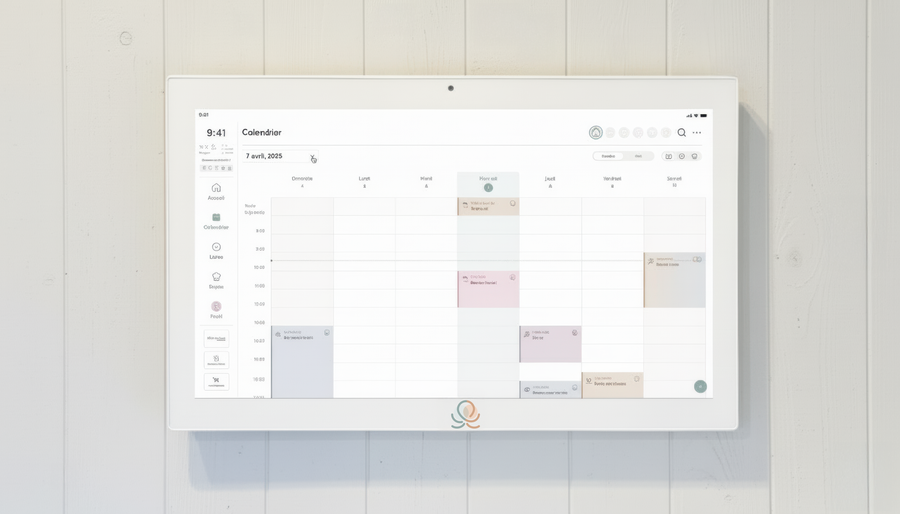
Get the whole family organized with Octave
Meals, chores, the calendar and routines for the whole family in one place: on everyone's phone and on the Station on your wall.
The app is free on iOS and Android.