



Create a game plan for family chores
08 June, 2025
Here we are: summer and the school vacation that everyone has been eagerly waiting for have finally arrived, and with them comes a unique window of opportunity to make changes or adopt new habits within your family cocoon. While the school schedule and work obligations usually dictate your pace, summer offers a precious flexibility that lets you rethink some of the ways you do things and get every family member involved in the daily routines. So seize the chance to finally involve your kids in the household chores and to establish habits that will surely last well beyond the vacation: the perfect game plan for a calm, harmonious back-to-school season!
Micromanagement vs. macromanagement
Are you used to managing daily life one day at a time, without a solid basic structure? This approach may seem less demanding at first glance, but it brings problems that could easily be avoided:
- Micromanagement puts the mental load of deciding every day which chore to assign to the kids squarely on the parents, and leaves the kids living in an unpredictable atmosphere.
- Your child wakes up every morning not knowing which chores they'll be asked to do (some mornings you ask them to vacuum, other mornings you demand that they empty the dishwasher, etc.), which also keeps them from taking responsibility on their own and showing independence.
- The family environment lacks consistency, a key element of parenting that gives children the emotional security and predictability they need to develop, while making it easier to learn family values and build their ability to self-regulate, on top of avoiding constant negotiations over limits and rules.
The solution? Macromanagement!
To lighten your mental load and encourage your kids to take a proactive part in family life, opt instead for a clear, visual and structured system that will let everyone enjoy a more productive and, above all, calmer summer, thanks to the many benefits of macromanagement:
- Boost your efficiency: instead of having to decide every morning what needs to get done and which family member will be responsible for it, a well-established system lets you set a clear game plan once and for all, with no more need to think about it!
- Choose a system that builds skills: macromanagement teaches your child a teamwork method that will surely be a huge help in their studies and in their future professional life.
- Calm parents: a well-structured system from the start will let you fully enjoy the nice weather too, thanks to all the times you'll no longer have to repeat yourself!
- A lighter mental load: want to wake up every morning with a light heart, ready to soak up the gentle rays of the sun? Dramatically lighten your mental load: there's no need to think every day about what has to be done, since everything has already been clearly decided!
Household chores on autopilot: a step-by-step guide
Step 1: chores up for auction
Set aside some time as a couple for the household chore auction! No need to pull out your wallet, just follow these few steps:
- Together, identify every chore that needs to be done in the house: doing the laundry, making dinner, cleaning the floors… everything needs to be on the list, from the chore that takes a few minutes to the one that demands more time and effort!
- Decide how often each chore needs to be done: since everyone has a different tolerance for dirt and dust, this discussion will certainly call for a few compromises! Your partner would like the floors washed every week, while you can easily put up with a month without cleaning? Meet halfway: wash the floors every two weeks, so that everyone is happy!
- Divide the responsibilities fairly: based on everyone's schedule and workload at their job as well as personal interests and skills, choose who is responsible for each of the chores you've identified. Of course, nothing stops you from revisiting this step a few times over the course of the year!
- Identify the chores that can be delegated to the kids: depending on each child's developmental level and degree of independence, as well as their summer schedule (Do they already have a summer job? Are they going to day camp?), identify the various chores your kids are able to do. To help you figure out their skills by age, check out our Independence Pathway available on Octave!
Step 2: find the system you like
Because our mission is to simplify your life and give you concrete ways to make your daily routine easier, we at Les Belles Combines have two perfect, turnkey systems that are easy to use and set up: it's up to you to choose the one that suits your family!
Option 1: Octave
Designed specifically to lighten parents' mental load, our Octave app is the perfect tool for efficient, structured planning of your family's daily life.
Scheduling recurring chores
Dinner obviously has to be made every day, just as the laundry often has to be done several times a week. With Octave, there's no need to write it on the calendar over and over: simply select how often the chore repeats and it will repeat automatically, with no extra effort on your part!
Automatic follow-up and notifications
Don't have the time or energy to make sure every delegated chore is properly done by your kids? Octave lets you track progress automatically and schedule notifications that will send the reminders for you: no more repeating yourself and following up, Octave does it for you!
Option 2: Household chore chart and Magnétos chore magnets
Don't want more screens and technology in your home, or simply prefer a physical, more tangible version of the system you'll put in place? Opt instead for our household chore chart, to be used with our perfectly complementary Magnétos!
A visual system kids can handle
Perfectly suited to little ones and big kids alike, our household chore chart is a visual system that's easy for children of all ages to understand. The Magnétos also let them interact hands-on with the chart, which is sure to boost their willingness to pitch in!
Done: the satisfaction of moving the magnets
A chore is finished? The matching magnet gets moved to the “Done” board assigned to your child: an effective way to boost motivation through the satisfying feeling of a job well done!
Step 3: assign chores based on your child's age and skills
Obviously, your three-year-old toddler can't vacuum effectively, just as it may not be challenging enough for your 13-year-old teen to have clearing the table as their only daily responsibility. It goes without saying that it's important to assign chores to each child while keeping these points in mind:
- Responsibilities suited to developmental abilities: take the time to properly assess your child's household chore skills; to do so, check out our Independence Pathway, which will give you guidance on the skills you can expect based on your child's age and developmental level.
- A logical progression of responsibilities: the chores you ask for should of course evolve over time as your child's skills develop. So if you eventually want to put your 12-year-old in charge of making dinner, start by asking them, from a young age, to wash the vegetables, then to cut them, and so on, until they can put together the whole meal.
- A balance between the right challenge and guaranteed success: make sure you give your child a challenge that matches their real skills, neither too easy nor too demanding! The chore should be hard enough to take some effort, but easy enough that your child doesn't get discouraged by the size of the job.
Step 4: putting the system in place and breaking it in
Here we are, at the final step: putting your system in place and breaking it in! To make sure it succeeds, be sure to follow these points:
- A period of adjustment and tweaks: like any new routine, your system needs an unavoidable adjustment period, during which everyone will not only have to get used to the new structure but also build their skills for the chores they've now been given. So give things time to settle in gradually, while allowing yourself to make a few adjustments if needed.
- Training the kids on the new system: just as new employees are given a training period, every new family system calls for the same with the kids. So take the time to clearly explain how the structure you've set up works, and give them the space and time to ask the questions that will make sure they understand what's expected of them and feel motivated to adopt the new routine.
- Regularly evaluating how well it works: after a few weeks, and regularly after that, take some time to evaluate the system's effectiveness. Does everyone know exactly what they have to do? Are the chores divided fairly? Is everyone really able to do what's asked of them? Of course, don't hesitate to make adjustments as needed!
That's it! You've done a great job and now it's time to reap what you've sown: fully and calmly enjoy these few lighter weeks as a family!
Put these tips into practice
Get the whole family organized with Octave
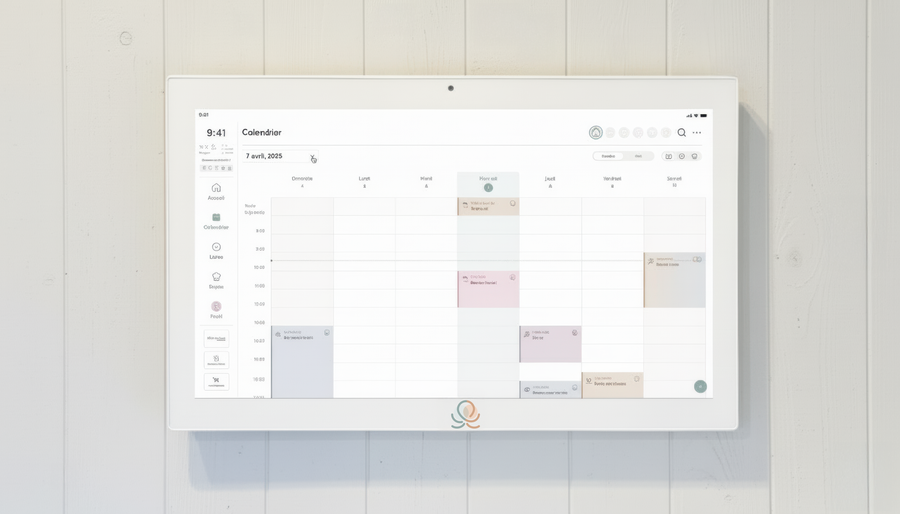
Meals, chores, the calendar and routines for the whole family in one place: on everyone's phone and on the Station on your wall.
The app is free on iOS and Android.