



10 warning signs: when planning smothers the family
01 April, 2025
By Dominique Bernèche
In the previous articles in our feature “A Family Schedule That Breathes,” we explored how to diagnose an overloaded family calendar, build in zen moments and adopt habits that optimize our time without wearing us out. But even with the best intentions, the trap of over-planning can insidiously close in on us.
As a family coach, I regularly see this phenomenon: families create organizing systems that are supposed to simplify their daily lives but end up smothering them. Many parents go through this phase where their organizational efficiency backfires on them. Let's look together at the warning signs that should make us react before we're completely smothered.
The “just one more thing” syndrome
“My planning is super well organized, I can certainly squeeze in this extra activity.” This seemingly innocent thought is often the first step into the spiral of overload.
Most organized parents fall into this trap: their organizing system becomes so “high-performing” that they start accepting more and more commitments. The calendar is impeccably managed... and totally unlivable. Often, without realizing it, that one little extra thing ends up taking the time we would have spent with the oldest, who goes to bed later than the others.
Warning sign #1: We catch ourselves regularly saying “it's just one more little thing” or “it won't take much time.” Those little things pile up and end up filling every bit of breathing room.
When transitions become races against the clock
A balanced schedule includes not only activities but also time to get from one to the next. When these transition moments turn into a permanent sprint, it's a clear signal that something is wrong.
It's a familiar feeling for many parents: having perfectly timed the trips (7 minutes to get to school, 12 to get to sports, 9 to get back from music class). Everything works... until a red light is longer than expected, a child can't find their shoe, or it simply rains. The slightest disruption and the whole schedule collapses like a house of cards.
Warning sign #2: We constantly find ourselves rushing the kids (“Hurry up!” “We don't have time!” “Faster!”) and anxiously watching the clock. Getting around is no longer a chance to connect but a logistics exercise.
The family algorithm that took over
Our digital tools are designed to optimize our time. But sometimes it's as if the tool itself were taking over the controls.
This phenomenon is more and more common: parents become slaves to their system, more afraid of disappointing their planning app than of disappointing their family. When the kids ask to play, the first thought isn't “do I want this time with them?” but “does it fit in the schedule?” Notifications become more important than the family's real needs.
Warning sign #3: We feel anxious at the idea of deviating from the schedule, even for good reasons. The tool has become the master rather than the servant.
Quality time turned quantitative
Ironically, our desire to be good parents and spend “quality time” with our kids can itself become problematic when it turns into a scheduled obligation, a box to check.
Conscientious parents often start scheduling “quality moments” with each of their kids. Monday evening: board game with the older one. Tuesday: reading with the younger one. This excessive structuring drains away all spontaneity and all enjoyment. The kids then feel the pressure of having to “have a good time” on command.
Warning sign #4: Moments of family connection feel more like business appointments than moments of shared enjoyment. Being present has become a task to complete rather than a moment to savour.
The disappearance of “doing nothing together”
One of the subtlest but most telling signs of overly rigid planning is the disappearance of those moments when the family is simply together, with no particular goal.
In many homes, the answer to this question is troubling: when was the last time the family simply “hung out” together? With no structured activity, no particular goal, just being there, together. Even relaxing evenings become scheduled, with a movie chosen in advance and precise timing for the popcorn and bedtime. That's a shame, because it's precisely these moments that let siblings build bonds.
Warning sign #5: We can't remember the last time the family simply hung around the house with no particular plan, or improvised an activity on a whim.
The physical giveaway: the family's energy level
Our bodies often send us signals that our busy minds ignore. An overloaded schedule inevitably shows up as physical signs of exhaustion.
In family coaching consultations, we regularly see families where every member constantly complains of fatigue: teens falling asleep over their homework, irritable young children, exhausted parents. And yet they're getting enough sleep. It's their pace of life that drains them.
Warning sign #6: Despite apparently adequate sleep, the family shows chronic signs of fatigue, irritability or resistance to usual activities.
The Sunday evening knot in the stomach
A schedule that smothers produces a characteristic emotional reaction: Sunday evening anxiety, when we contemplate the week ahead.
For many parents, looking at the week's schedule becomes a moment of tension rather than positive organization. When we dread the week ahead and it makes us more anxious than excited, that's a powerful alarm signal.
Warning sign #7: The shift from the weekend to the week comes with a collective feeling of heaviness or apprehension.
When meals become logistical interludes
Family meals are traditionally moments of reconnection. But in an over-planned system, they can turn into mere functional pauses.
In many homes, meals become refuelling stops between two activities. We eat fast, sometimes even in front of screens, talking mainly about who needs to be where next and what needs to be prepared for tomorrow. Real conversations have long since disappeared.
Warning sign #8: Family meals are centred on logistics rather than connection. Conversations revolve mainly around scheduling, homework to finish or arrangements for the next day.
Activities that are supposed to be fun turned into chores
The ultimate goal of family planning is to make moments of joy and fulfilment easier. Paradoxically, over-planning can turn those very activities into stressful obligations.
This phenomenon is common in kids: they loved their dance, music or sports class, but since we added two more activities to their schedule, they drag their feet going. It's no longer a pleasure but one more box to check in an already overly full week.
Warning sign #9: Activities that were once sources of joy are now approached with reluctance or resignation. Passions look dangerously like obligations.
Hobbies turned into performances
In our culture of optimization, even hobbies aren't safe from the tyranny of performance.
Many adults turn their leisure activities into extensions of their work. Running is no longer a time to clear your head but a chance to break records. Reading becomes a competition against yourself to finish more books. Even relaxing activities become sources of pressure.
Warning sign #10: Leisure activities are approached with the same performance and optimization mindset as work. Pleasure has given way to goals.
How do we reverse course? The smothering-schedule audit
If you recognize several of these signs in your family life, it's time to carry out a “smothering audit.” Here is a simple three-step approach used in family coaching:
1. Observing without judgment
Take a week to simply observe – without immediately trying to change things. Note the moments when:
- You feel a pang of time-related anxiety
- Your kids seem overwhelmed or resistant
- Transitions are particularly tense
- You feel constrained by your own system
2. The cascading “why” test
For each activity that creates tension, ask yourself “why?” at least three times:
- Why are we doing this activity?
- Why is it important to us?
- Why do we have to do it now/so often/this way?
This simple but powerful technique helps you tell what truly has value for your family from what has taken hold out of habit or outside pressure.
3. Applying the 80/20 rule, revisited
Remember the fundamental principle we mentioned in our second article: only firmly plan 80% of your available time, keeping 20% for the unexpected and for spontaneity.
If your audit reveals that you're beyond that limit, it's time to make courageous choices. Ask yourself these questions:
- Which activities bring us the most joy and meaning for the least stress?
- What can be put off to a later season of our lives?
- Which expectations can we adjust (our own or other people's)?
Many families have made the difficult but liberating decision to pause certain activities. The effect on their quality of life was immediate and profound.
The adjustments that make a difference
Rather than turning everything upside down, small adjustments can sometimes be enough to give a suffocating schedule some oxygen again:
- The transition buffer: Systematically add 15 minutes of cushion between each activity or trip.
- The no-planning day: Set up one day a month when nothing is scheduled in advance. No plans, no expectations.
- The substitution rule: For every new activity added, another one must be dropped or reduced.
- The check-in moment: Make a habit of regularly asking each family member: “How do you feel about our current pace?”
Conclusion: toward planning that serves life
Our era celebrates productivity and optimization as cardinal virtues. Yet even the most sophisticated family organization is only worth something if it supports what really matters: connection, shared joy and the feeling of having enough space to simply be.
The ideal schedule isn't the one that lets us do more, but the one that creates the conditions for us to be fully present – to ourselves and to one another. It gives us the ultimate luxury: that of sometimes forgetting the time and letting ourselves be carried by the present moment.
The real success of a family organization system isn't when everything works perfectly, but when it lets you forget it exists. When the family is so absorbed in the pleasure of being together that it no longer even thinks about planning – that's where balance is found.
This article is part of our special feature “A Family Schedule That Breathes,” published in the April 2025 issue.
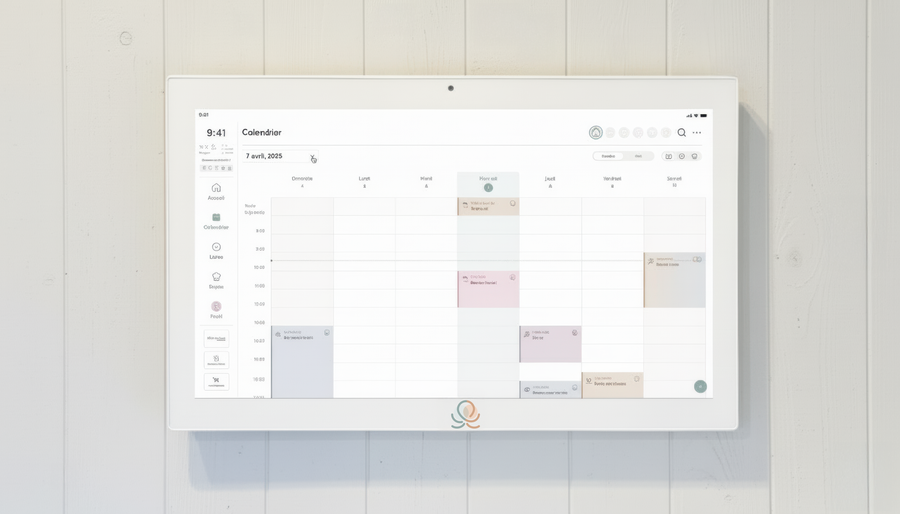
Put these tips into practice
Get the whole family organized with Octave
Meals, chores, the calendar and routines for the whole family in one place: on everyone's phone and on the Station on your wall.
The app is free on iOS and Android.