


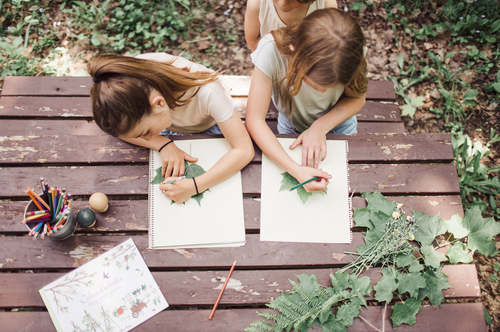
The leaf hunt: the springtime activity that breathes
21 April, 2025
After exploring our special feature on the family schedule that breathes, you may have started building moments of pause into your daily organization. Spring, with its burst of greenery and renewal, is a perfect chance to put that philosophy into practice through an activity as simple as it is enriching: nature walks and exploring tree species.
An activity your kids will love (yes, really!)
We wrongly assume that identifying trees won't interest kids... and yet it does! I've seen my own kids challenge each other to see who could identify the most different tree species, and then proudly share that knowledge with their friends. My kids love trees; they've even named the trees they climb, Gérald and Micheline.
Don't see this suggestion as one more educational activity to squeeze into an already overloaded calendar. Think of it instead as a moment of connection that fits naturally into your daily life. These walks perfectly embody the spirit of our schedule that breathes:
At our house, these explorations happen without a watch or a timetable – sometimes 15 minutes on the way home from school, sometimes a whole weekend morning. The kids set the pace, and it's often they who remind us to check whether “our” oak has started to bud.
Learning happens joyfully and almost by accident, between two games of chase or the discovery of an insect. One day, you'll realize the whole family can spontaneously name a dozen trees – without ever feeling like you were studying.
These moments create precious memories – my daughter still remembers the time she discovered the difference between a fir and a spruce by rolling their needles between her fingers, a secret she proudly shares with her friends.
Spreading it out over time is the whole beauty of this activity – we follow “our” trees over the weeks, watching the subtle changes spring brings them. This slowness is the perfect antidote to our generally rushed lives.
Kids' natural curiosity finds an ideal playground here. Discovering plants whose leaves are full of a substance that looks like glue, cocoons filled with what looks almost like feathers. “How does the tree know it's spring?” These questions open wonderful conversations that would never have happened in front of the TV or while waiting for the end of big brother's hockey game.
Pokémon vs. trees: a revealing paradox
It was François Cardinal, in his book “Perdu sans la nature” (“Lost Without Nature”), who pointed out how striking it is that our kids can effortlessly memorize the names, types and evolutions of hundreds of Pokémon, yet often struggle to identify five tree species in their own surroundings. This paradox reveals less a lack of ability than a question of exposure and cultivated interest.
This observation isn't a criticism of Pokémon or of kids' modern interests, but rather an invitation to redirect some of that tremendous learning capacity toward the concrete natural world – the one they can touch, smell and interact with every day.
Exploring in stages
The great thing about this activity is that it doesn't need to be done all at once. It can naturally spread out over days and weeks, respecting your family's rhythm:
Step one: awakening the senses (15 to 30 minutes)
On an ordinary walk in your neighbourhood or an outing in nature, simply take the time to notice the different shades of green around you.
-
Invite the kids to gently touch the new leaves
-
Compare their textures: some are fuzzy, others smooth or waxy
-
Look at the different shapes: serrated, oval, fan-shaped
No need to identify anything at this stage – the goal is simply to awaken curiosity and attention.
Step two: the relaxed collection (30 to 45 minutes)
On another outing, bring along a paper bag or a small notebook to collect a few specimens (always taking care to respect nature):
-
Gently pick one or two leaves from each type of tree you come across
-
Place them between two pages of your notebook or in separate sleeves
-
If you like, take photos of the whole tree to help you identify it later
No pressure here either: if you only collect two or three varieties, that's perfect. There will be other chances.
Step three: stress-free identification (20 to 30 minutes)
Back home, in a quiet moment, flip through an identification guide together or use an app like PlantNet to find out the names of the trees whose leaves you collected.
Common tree species in Québec that you might come across include:
-
The yellow birch (our provincial tree)
-
The sugar maple or the red maple
-
The red oak
-
The American beech
-
The trembling aspen
Feel free to write the names right on the pages of your notebook, next to the pressed specimens.
Turning learning into a game: the tree memory game
Once you've identified a few species, why not create a game that will cement that knowledge while offering moments of shared fun? The tree memory game is perfect for that. Plus, it will certainly fill a protected time slot in your family schedule. It's an activity kids can do without your help while you read a few pages of your book.
Materials needed:
-
Blank cards of identical size (index cards cut in half work perfectly)
-
A pair of leaves from each tree species you've identified
-
A glue stick
-
A felt marker to write the names of the trees (optional)
Making the game:
-
Glue each of the leaves onto a card with the glue stick. You can also add the name of the species under the leaf.
-
Then shuffle all the cards and lay them face down on a table in a grid.
-
Taking turns, each player flips over two cards. If they make a pair, they keep them and go again. If not, they flip them back over and it's the next player's turn.
-
The player with the most pairs at the end of the game wins.
This simple game can be pulled out during downtime, when the kids are bored or on a rainy evening.
The secret of an activity that breathes
The beauty of this tree exploration lies in its lack of pressure and its ability to fit naturally into your daily life. Here are a few principles to keep it true to the spirit of the “schedule that breathes”:
-
Don't set ambitious goals: you don't need to identify every tree in your region. Even knowing just 3 or 4 will have enriched your connection with your surroundings.
-
Build this activity into your usual trips: the route to school, walking the dog or an outing to the park can all become chances to observe.
-
Let the kids' interest guide the experience: some will be fascinated by shapes, others by names or the history of trees. Follow their curiosity rather than imposing an approach.
-
Accept interruptions: if the activity is set aside for a few weeks, no big deal. It can be picked back up at any time.
Conclusion: an activity that reflects your schedule that breathes
This spring exploration of tree species perfectly illustrates what we've championed throughout our special feature: a family organization that leaves room for wonder, spontaneity and everyone's natural rhythm.
In a world where attention is constantly pulled and fragmented, taking the time to notice the subtle difference between a maple leaf and an oak leaf is an almost revolutionary act. It's affirming that slowness has its place, that careful observation has value, and that the connections we weave – with nature and with each other – are precious.
As spring unfolds its symphony of tender greens, treat yourselves to these moments of shared discovery. Your family schedule will breathe easier... and so will you.
Although this article complements our special feature “A Family Schedule That Breathes,” it can be enjoyed on its own as an invitation to slow down and watch nature wake up.

Put these tips into practice
Get the whole family organized with Octave
Meals, chores, the calendar and routines for the whole family in one place: on everyone's phone and on the Station on your wall.
The app is free on iOS and Android.