



The 5@8 Screen-Free Challenge: tips and tricks for managing screen time
30 October, 2018
A few years ago, I was struck by a major rethink about my own screen use and also, and above all, about the role model I was being for my children. As the president of a small, fast-growing company, I was managing social media on my own at the time. I was totally in FOMO (fear of missing out) mode. It mattered to me to know everything that was happening on my company's Facebook page, and in real time, too! I also had, at that time, a two-year-old girl who demanded the screen at every moment and could throw a terrible tantrum to get it! Watching the documentary Bye by Alexandre Taillefer (in French) was a real wake-up call for me! From then on, I set myself a challenge: not to turn on screens in front of my children between 5 p.m. and 8 p.m. I later put that challenge out to a multitude of families.
A challenge that has lasted for several years
It's clear that our family has been taking up the challenge for more than a year now. The past few years have taught me a lot about the whys and hows of screen management. I also came to understand that it was necessary to make children responsible for managing their own screen time. Like everything Les Belles Combines sets out to offer, we decided to put children at the centre of their own learning and gradually lead them toward self-regulation. So here are the key points of my approach.
- Learning self-regulation, or setting clear, consistent and coherent rules
Encouraging our children's independence also means teaching them to manage their own screen use. Much as we teach them the importance of eating well (having 5 servings of fruits and vegetables, eating healthy snacks, limiting sugary foods, etc.), we have to give them certain guideposts so they can use screens in a healthy way. After the first edition of the “5@8 Screen-Free Challenge,” we held a little family meeting (find out how the family meeting works in the monthly Family Manager subscription!) to decide with the kids on new rules for screen use. So here are our family's five rules about screen time:
- No screens between 5 p.m. and 8 p.m. on weekdays, unless you have a privilege! (Here, we use Les Belles Combines privilege coupons: 10 tokens earned through the General Store are worth 30 minutes of tablet or TV time)
- NEVER any screens before leaving for school: children need to keep all of their ability to concentrate for the day ahead.
- A maximum of 30 consecutive minutes of screen use for the older kids and 20 minutes for the younger ones.
- Before turning on a screen, make sure you've done enough things to properly stimulate your brain (we refer to the poster Do you feel like turning on a screen?)
It's much easier to manage screens since the rules have been clear. Before, we had the unfortunate habit of letting them play video games or watch TV, losing track of time ourselves, then suddenly stepping in by telling them “You've watched enough, we're stopping!” As you probably know, that kind of intervention is rarely well received by children and, above all, it doesn't let them understand what proper screen use looks like.
- Encouraging activities that engage the senses
It goes without saying that to be able to forget about screens, you'll have to replace the time that used to go to them with something else. Here, all together, we drew up the evening schedule and realized that in reality, we have very little time to give to screens. First, the kids have to do 15 minutes of schoolwork and 15 minutes of piano. On top of that, they have a chore to do every day that takes about 15 minutes of their time. Once dinner is done and baths are taken, we only had about 45 minutes left to fill (to help your kids follow the routine set after school, use our small chore charts!)
At the very beginning, we suggested activities to the kids: board games, drawing, cooking, reading, a physical exercise routine with Mom and Dad, and so on. Then, over time, we left more room for boredom. We know that boredom stimulates the imagination. On the subject of kids and screens, English-speaking families might try The Anxious Generation by Jonathan Haidt. As Tristan Demers puts it in his French-language essay “L'imaginaire en déroute,” “a human being whose brain is constantly buzzing will be able to give everyday events a new meaning and find solutions to problems more easily”. In other words, cut back on screen time and let kids get bored, and you'll end up with much more resourceful kids. A very interesting way to stimulate creativity is to leave little invitations to create or experiment lying around: leaving books or games on the kitchen table to spark kids' interest (a book on origami or on learning to draw animals, for example) will be very effective not only for keeping kids busy but also for helping them discover new interests and develop different skills.
- Choosing the programming and providing guidance
Finally, we also had to structure screen time. My son spent most of his screen time watching National Geographic videos and informative videos about animals. He learned lots of things and repeated them to me without my asking. My daughter, on the other hand, loved toy-presentation videos on YouTube: nothing very stimulating about watching ladies unbox PAW Patrol figurines and show them off to kids!
So I no longer leave them alone behind a screen but, as Serge Tisseron (in French) would put it, in front of a “program.” He is the author of “3-6-9-12: Taming Screens and Growing Up” (in French). I choose a few interesting apps or I send them to the website of the NFB, which is full of culturally stimulating shows. Then, when they're done, I ask them to tell me in their own words what they saw or did on the screen. This helps them develop their sense of narrative: using a before, during and after. That way, screen use becomes an enrichment! Because it's important to say so, we're far from being technophobes! It seems important to point out that when we put all of this in place, my children were all eight or younger. So we started with the basics.
We still have a long way to go. Next, we'll need to make them aware of the mysteries of the web. What is real information and what is fake? How do you behave safely online? How do you respect your own privacy and that of the people around us? In short, there's so much to do and learn that there will surely be several more editions of the 5@8 Screen-Free Challenge! Until then, if you have teens or pre-teens, take a look at our Cell Phone Use Contract printable. And, to help you set rules for screen use at home according to your children's ages, we've also prepared a handy reference sheet on Serge Tisseron's 3-6-9-12 rule that will let you introduce the right screens, in the right way and at the right time into your children's lives.
Don't forget to follow our Facebook page and our Instagram account to stay on top of the next edition of our 5@8 Screen-Free Challenge!
Tisseron, S. (2013). 3-6-9-12 Apprivoiser les écrans et grandir (Taming Screens and Growing Up). Eres, Toulouse. Demers, T. (2018), L'imaginaire en déroute (Imagination in Disarray), Les Éditions de l'homme, Montreal.
Want to be the first to see everything published in the Magazine each month, and get access to our Toolbox, which includes, among other things, free downloads that are as practical as they are fun? Subscribe to Belles Combines Magazine today!
Put these tips into practice
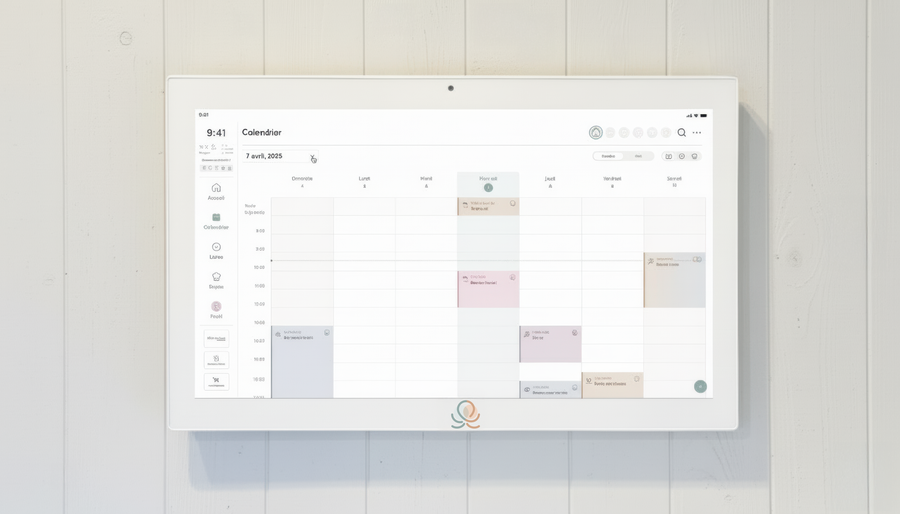
Get the whole family organized with Octave
Meals, chores, the calendar and routines for the whole family in one place: on everyone's phone and on the Station on your wall.
The app is free on iOS and Android.