


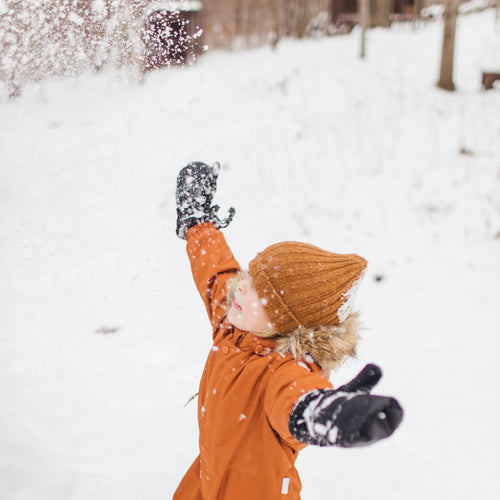
Nature as a Playground: Benefits and Tips for Thriving Children
22 February, 2023
Almost every weekend, during school holidays or spring break, we escape into the forest as a family. Ever since I was little, I've spent a lot of time in the woods, as my now-retired father was a forestry entrepreneur. He would prospect land, cut timber, and resell it in small lots. My father is the kind of man who knows every type of tree, has an extraordinary sense of direction in the forest, and knows every animal species and its characteristics. He showed me so many lakes and rivers! When I was younger, I'd walk up streams, rain boots on and backpack ready. I'd turn over every rock to discover the insects and reptiles hiding there. I caught frogs and small fish, observed turtles, beavers, hares, and deer. We even operated a small family sugar bush for a time and had a log cabin with no running water or electricity. These are by far my fondest memories. Just ask my childhood friends, who often joined us for a weekend; I'm sure they have memories just as good as mine.
Naturally, I wanted my children to experience the same. A few years ago, my husband and I, with the help of my father and other family members, built a lovely log cabin without running water or electricity on the banks of the Ouareau River. We did it the hard way! We peeled each tree that makes up the walls and assembled everything ourselves. The children learned that at the beginning of summer, spruce and fir trees fill with sap between the wood and the bark, making it easy to remove the bark, much like peeling a banana. Now that the construction is finished, we genuinely enjoy spending a large part of our weekends and holidays there.
Over time, I've noticed that my children are easier to live with there than at home. My oldest, Louis, for instance, is a energetic boy, a bit quick-tempered, who thrives on sports and physical activity. When he's bored and doesn't channel this energy, he tends to annoy everything that moves in the house. Surprisingly, when we're at the cabin, it's a completely different story. He's so busy playing in the forest, discovering and exploring, that he doesn't bother anyone. I've also observed much more collaborative play, good understanding, great projects, and evenings cut short by extreme fatigue. When we're at the cabin, I suddenly have more time for myself because the children occupy themselves with free play. So, I started to become interested in this relationship between children and nature. I read a few books, including The Last Child in the Woods by Richard Louv and Perdus sans la nature by François Cardinal, to name just a few, and I realized a lot of things. In fact, every parent should read François Cardinal's book. It's easy to read and brings about a wonderful awareness of many things.
Our children need to channel their energy and stress because, as Sonia Lupien, director of the Human Stress Studies Centre and scientific director of the Fernand Séguin Research Centre affiliated with Louis-H Lafontaine Hospital, so rightly puts it, children's stress accumulates like a kind of "energy in the belly." Without realizing it, our children experience small or larger stresses every day, whether it's an argument with a friend, a bad grade, a dispute with parents, or even a divorce. If the child "doesn't get rid of this energy, it will end up in the brain, which will have negative effects on their ability to learn, to memorize, and on their emotional regulation."
The connection to nature is therefore extremely important, because it is in nature that the child is best placed to play freely and channel this energy, like my older son Louis, who feels so good in the forest and has less need to annoy others to release his big ball of stress and energy. A study published in 2008 in the Journal of Attention Disorders revealed that a 20-minute walk in a green space allowed children with ADHD to regain a concentration ability very close to that of children without any disorder. Andrea Faber Taylor, co-author of the study and professor at the University of Illinois, said she "found that the effect of a dose of nature was as pronounced, if not more so, than a dose of medication."
Do you live in the suburbs and nature seems difficult to access?
Without us realizing it, nature is gradually disappearing from our children's lives. Unfortunately, this disappearance is not without impact. Their mental and physical health is significantly affected. The increase in obesity and ADHD cases are excellent examples of this. Know that you don't need to isolate yourself deep in the woods without electricity and running water, as we do, to reconnect with nature. In fact, nature is your backyard or the park around the corner. But if you can afford it, take advantage of the holidays to get a little further or a little longer into nature:
- Rent a cabin
There are many cabin rental sites, from Chalet à louer to Airbnb. It's very easy to find a place to escape where your children can play freely, without structure and too much parental supervision: invent a world, build a cabin with fir branches, in short, give free rein to their creativity.
- Visit a nature park
Take advantage of the weekend to go for a hike on a trail or a picnic in the mountains, and take the time to touch, smell, and feel nature! And why not use our little trick Nature Treasure Hunt as a lever for exploration? Visit SEPAQ to find a place near you.
- Visit the Ecomuseum
I discovered this extraordinary place during spring break. It's the ideal place to discover Quebec's animal species, and it's only 30 minutes from Montreal. As François Cardinal so rightly says in his book, "studies show that children can call Bakugan and Pokémon by their first names, but are unable to name trees, birds, and plants by their names." I fully intend to visit this place several times a year so that my children can see for themselves how much animals change with the seasons, and even that some simply sleep all winter. The place is easily accessible, and the animals living in a natural environment seem well cared for and healthy.
- Plant a garden
This is a great way to develop your child's knowledge of nature's contribution to our diet and about food itself. A small garden or even a few pots on your apartment balcony can do the trick. Our little trick My Vegetable Garden will certainly help you create the garden you desire!
Would you like to have the opportunity to consult all the content published in the Magazine each month in preview, and have access to our Toolbox including practical and fun free downloads? Subscribe to Belles Combines Magazine now!
1 comment
Excellente idée l’Éco-musée! Bien hâte d’y aller :)