



I'm always on the move, I'm smart: tips and tricks to support learning with an active child
08 May, 2018
Does your little one have the wiggles? Do they need to be active and handle things in order to concentrate? Is learning harder because they have trouble sitting still for long stretches? Your child may simply have a dominant kinesthetic intelligence. This article is about that form of intelligence, which is one of the multiple intelligences. I'll paint a picture of its characteristics and of how your child learns if this is their dominant profile. There will also be suggestions to make homework, studying or activities easier while respecting your child's energetic personality.
But first, what is kinesthetic intelligence?
A little theory
Kinesthetic intelligence is one of the eight multiple intelligences proposed by Howard Gardner's theory. This theory was first proposed in 1983. In that version, there were only seven forms of multiple intelligences:
- Linguistic intelligence
- Logical-mathematical intelligence
- Visual-spatial intelligence
- Intrapersonal intelligence
- Interpersonal intelligence
- Kinesthetic intelligence (also called bodily intelligence)
- Musical intelligence
The author proposes that every individual comes into the world with all seven intelligences. Throughout life, each intelligence will develop at a different pace and to a different level. Usually, one or two intelligences stand out as dominant. These will shape how that person perceives and approaches life. Each of us is different depending on how developed our various intelligences are. That's what makes us unique! The theory was expanded in 1993, when naturalist intelligence was added. In many Québec schools, Gardner's work is used to help children get to know themselves better and develop learning and work strategies suited to their personalities. The theory of multiple intelligences also soothes the self-esteem of children (or teens) who don't feel “good” or “competent” simply because the methods offered to them so far didn't match their intelligence profile.
What does it look like in practice?
Each intelligence has its own particular traits. A child with a dominant kinesthetic intelligence generally has the following characteristics:
- Likes to be in action and on the move
- Is hands-on and good with their hands
- Is good at sports and enjoys physical activity
- Learns by handling and touching
- Has good fine motor skills and dexterity
- Has good gross motor skills and is in control of their body and movements
And when it comes to learning, how do we go about it?
Is your child restless at homework time? Do they wiggle in their chair or constantly play with their supplies? Do they tend not to read the instructions and “dive” into the task right away? Is concentrating difficult? Do you feel they constantly need to move? There's a good chance your little one has a kinesthetic dominance! If so, there are many ways to adapt “homework hour” to their more active dominance. Here are a few; have fun modifying them to suit your context and your reality. In concrete terms, a child with a kinesthetic dominance needs:
- to be active
- to move
- to handle things
- to feel
First, your child can do a short exercise session (skipping rope, jumping jacks, running, etc.), followed by a relaxation session (yoga, breathing exercises) before starting homework or study time. Physical activity lets them burn off their extra energy, and relaxation helps them settle down so they're available and more focused.
For “by heart” memorization tasks, such as spelling vocabulary words, conjugating verbs or studying the different tables (addition, subtraction, etc.), you can ask your child to do it:
- by tossing a ball to you
- by jumping in place, doing jumping jacks
- by using materials (magnetic letters and numbers, Scrabble tiles)
- by aiming a ball at a target
To help them memorize, suggest walking or sitting on an exercise ball. The movement will help them concentrate.
For solving math problems, using hands-on manipulatives is very helpful. These can be tokens, marbles, cubes, but also pebbles or pasta (uncooked!). Using a dry-erase board can also be useful for problems that need a visual aid.
To prepare for a test on a specific subject or for a recitation (the concepts being studied are known in advance), have them put together a “Questions and Answers” game. They'll stay active while reviewing the important concepts for the test.
It's common for children with a dominant kinesthetic intelligence to be drawn to drama. Study sessions can be adapted with role-playing or miming. For little ones, puppets can also be a great option.
You can also let your child work standing up. If they spend their time wiggling in their chair, it's mainly because it helps them concentrate. Standing, they can move their feet and body, which lets them focus better and be more comfortable. If you can put up large sheets of paper or a board on the wall for them to work on, it will help them experiment and stay in action.
Overall, for studying, try using lab equipment, manipulatives, a globe, modelling clay, sports equipment (balls, rackets, mini hockey nets), building blocks, costumes, and so on. The more your child moves and handles things, the more focused they'll be and the easier their learning will be.
Is my child hyperactive?
A child who needs to handle, touch and move should not be confused with a child who has attention deficit hyperactivity disorder. They're not the same thing. Just because your child has a dominant kinesthetic intelligence doesn't mean they'll be diagnosed with ADHD. It's simply that they learn this way. However, it can be beneficial for a hyperactive child to be put into action and to be able to express all their energy through physical activities, much like children with a kinesthetic dominance.
Do you recognize your little one? Do you think they have a dominant kinesthetic intelligence? What are your tricks for respecting their energetic personality in daily life and in their learning?
Would you like first access to all the content published in the Magazine each month, plus our Toolbox, which includes, among other things, free downloads that are as practical as they are fun? Subscribe to Belles Combines Magazine today!
Put these tips into practice
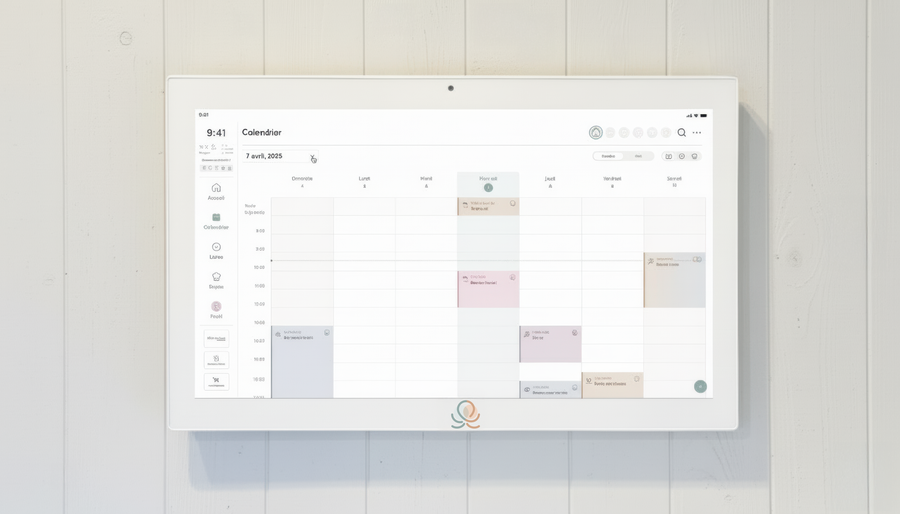
Get the whole family organized with Octave
Meals, chores, the calendar and routines for the whole family in one place: on everyone's phone and on the Station on your wall.
The app is free on iOS and Android.