


How to stop saying “Clean your room” 100 times
16 October, 2025
“Clean your room.”
“I told you to clean your room.”
“Clean. Your. Room. Now.”
“CLEAN YOUR ROOM!”
If this escalation sounds familiar, take comfort: you're not alone! Millions of parents repeat the same instructions over and over, every single day, until they're vocally and emotionally worn out. You feel like a broken record, and like your child is ignoring you completely.
Yet the more you repeat yourself, the less it works. But that's not because your child is being difficult; it's neuroscience!
The neuroscience of repetition: why it backfires
You may think that repeating an instruction makes it clearer, more important and even harder to ignore. In reality, the exact opposite happens in your child's brain.
The desensitization phenomenon
Imagine a car alarm going off nonstop on your street. For the first few minutes it's impossible to ignore and your brain is probably on alert. But after 20 minutes, you can barely hear it anymore. Your brain has filed that sound under “non-urgent background noise” and filtered it out.
That's exactly what happens when you constantly repeat the same instructions to your child.
The first time you say “Clean your room,” their brain registers the information. The second time, a few minutes later, their brain thinks: “Oh, she's saying it again. It's probably not that urgent then.” By the fifth repetition, their brain has completely tuned out your voice; you've become background noise.
This process is called habituation: a coping mechanism that keeps the brain from being constantly overwhelmed by repetitive stimuli.
The unintended message you're sending
When you repeat an instruction 10 times before really demanding the action you asked for, you unintentionally teach your child: “The first nine times don't count. I can ignore it until Mom uses THE voice.”
Your child learns to wait for the real signal – usually your exasperation or your anger – before acting. You create a system where only emotional escalation works and, even worse, you train your child not to listen to your normal voice.
Why constant reminders fail every time
Beyond neurological desensitization, constant reminders often fail for several reasons.
Reason 1: They make your child dependent on your memory
When you constantly remind your child what they have to do, you become their external executive brain. They have no reason to develop their own ability to remember and to start tasks – you do it for them.
The result? A 12-year-old who still can't handle their responsibilities on their own because they never had to develop that skill. While you think you're helping them by endlessly reminding them what to do, you're actually keeping them from learning.
Reason 2: They create a power struggle
After the fifth repetition, it's no longer about cleaning the room. It has turned into a battle: “Are you going to obey me?” versus “Do I HAVE to obey?”
The child is now resisting to assert their independence, not because they truly refuse to tidy up.
Reason 3: They don't take into account how a child's brain works
Verbal reminders activate the auditory cortex and the prefrontal cortex. However, in children, especially younger ones, the prefrontal cortex is immature. It has a hard time turning an auditory stimulus into a delayed action.
What's more, if your child is busy (playing, reading or building something, for example), their brain is focused on that activity. Your verbal reminder literally goes in one ear and out the other – it's not defiance, it's neurology!
Reason 4: They have no clear consequences
When you remind your child 10 times what they have to do without ever following through with a consequence, your child learns that there's no real cost to ignoring your requests. Why stop playing now if Mom is just going to repeat the same instruction for another 20 minutes? Without a predictable, consistent consequence, reminders are just hot air.
Visual systems that really work
So the solution isn't to yell louder or repeat yourself with more conviction. The solution is to replace your voice with external visual systems that do the reminding for you.
System 1: The laminated checklist + dry-erase marker
What it is: A visual list of tasks to complete, printed and laminated, that your child can check off with a dry-erase marker.
Why it works:
- It's visual: the brain processes images much faster than words
- It's tangible: your child can physically interact with the list
- It's rewarding: checking a box triggers a small release of dopamine
- It's independent: your child consults the list, not you
System 2: The visual timer
What it is: A timer that shows time passing visually, often with a coloured area that gradually shrinks.
Why it works:
- Children have no intuitive sense of time passing
- “In 10 minutes” means nothing to a 7-year-old's brain
- A visual timer makes time concrete and observable
How to use it:
- Announce the task AND the time allowed.
- Start the timer in front of your child.
- Put the timer somewhere visible.
- When the timer goes off, check that the task is really done. Apply a logical consequence if it isn't.
System 3: The star chart
What it is: A visual chart where your child earns a star, a sticker or a check mark for every task completed without a reminder.
Why it works:
- Children's brains generally respond very well to visual reward systems.
- It's concrete and immediate (unlike vague, distant rewards).
- It creates intrinsic motivation: your child wants to fill in their chart.
How to set it up:
- Create a simple weekly chart: days of the week across the top, tasks down the left side.
- Set a clear criterion: the star is earned if the task is done without a reminder (or with one reminder at most, depending on your goal).
- Your child places their own star: at the end of the day or right after finishing the task, they stick on or draw their star. This physical action reinforces the feeling of accomplishment.
- Celebrate progress, not perfection.
Important: The star chart is not a punishment system. You NEVER take stars away. You only celebrate the ones that are earned.
How it evolves: After a few months, once the behaviour is well established, gradually phase out the chart for that specific task. The goal is for intrinsic pride to eventually replace the external reward.
The replacement script: “Check your checklist”
Now that your visual systems are in place, your vocabulary has to change if they're going to be effective!
Before:
You: “Clean your room.” (10 minutes later) “I told you to clean your room!” (5 minutes later) “Why isn't your room clean?” (10 minutes later, raised voice) “CLEAN YOUR ROOM NOW!”
Result: You're exhausted, your child is frustrated and you've repeated yourself 4 times.
After:
You: “It's time to clean your room. Check your checklist to help you. The timer's started.”
(You leave. You don't come back in 5 minutes to check. You let the system do its job.)
When the timer goes off, you come back and say: “Time's up. Show me your checklist.”
Script variations by situation
If your child says “I forgot”: “Your checklist is on your door. Go check it.”
(No repeating the task. You redirect them to the system.)
If your child is dragging their feet: “Look at your timer. How much time do you have left?”
(You're teaching them to check the tool, not to depend on your reminders.)
If your child asks for help: “What's the first thing on your checklist? Start with that, then come see me if you get stuck.”
(You encourage independence before assistance.)
When it's done: “You finished your checklist in the time you had! You must be proud of yourself. Go put your star on the chart.”
(Celebration and positive reinforcement.)
The golden rule: “Ask once, then consequence”
Here's the rule that changes everything and supports all the visual systems: You ask once. Just once. Then there's a natural or logical consequence.
How to apply this rule
Step 1: One clear, single instruction
“It's 4 p.m. It's time to clean your room. Your checklist is waiting for you, and the timer is set for 15 minutes.”
You say this once, calmly, looking your child in the eye to make sure they heard. You're not angry, you're not pleading. You're neutral and matter-of-fact.
Step 2: You leave
You leave the room. You don't come back to check in 3 minutes. You don't shout reminders from the living room. You trust the system.
This step is CRUCIAL. By staying to supervise or remind, you undermine how the system works. Your child needs to learn that the instruction is serious the first time.
Step 3: The timer goes off (or the agreed time arrives)
You come back. You check the state of the room against the checklist.
Step 4: The consequence applies
If the task is done: “Excellent! Your room is tidy according to your checklist. You can now [next planned activity].”
Celebrate briefly, acknowledge the effort and move on.
If the task is NOT done: Here, no anger, no lecture, no “I told you so!” Just a natural or logical consequence, applied calmly.
Effective consequences
Natural consequence (preferred whenever possible):
“Your room isn't tidy. Unfortunately, you won't be able to have a friend over this afternoon because your room isn't welcoming. You can finish tidying up now, and we can plan a friend's visit another time.”
Logical consequence (when a natural one isn't easy to find):
“Your room wasn't tidy in the time we agreed on. The time you would have had to play outside will now go toward finishing the tidying. When that's done, you can enjoy whatever time is left.”
What does NOT work as a consequence:
- Punishments unrelated to the task (“No dessert tonight!”)
- Disproportionate consequences (“No screens for a month!”)
- Empty threats that you won't follow through on
The Belles Combines solutions
Our magnetic, dry-erase chore chart lets your child quickly and easily see what's left for them to do: no more reminders from you!
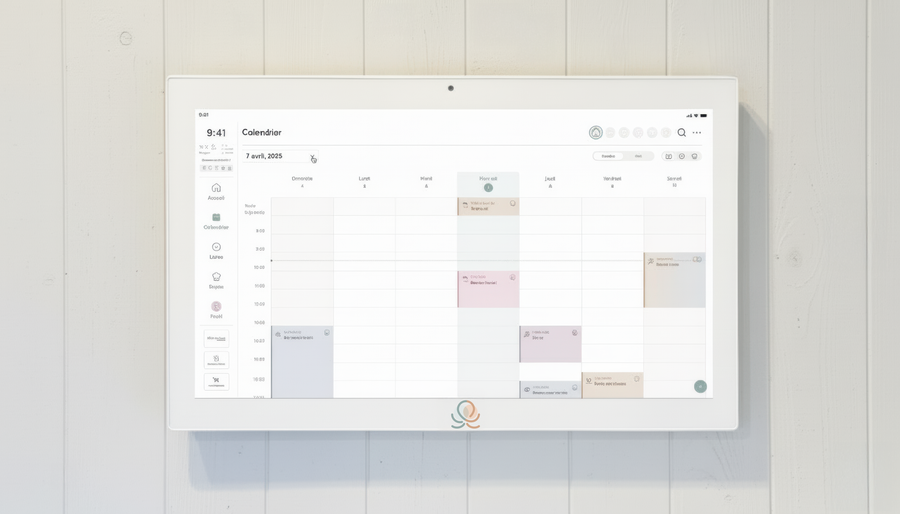
Our Octave app automatically sends your child notifications about the tasks they need to do. No more reminders, your virtual family assistant does it for you!
Stopping the 100 repetitions isn't a matter of willpower or strict discipline. It's a matter of smart systems that replace your worn-out voice with effective visual tools.
Checklists, timers and star charts do the reminding while you maintain the structure with the “one instruction, then consequence” rule. The result? A more independent child, a less tense parent-child relationship, and a home where nobody has to yell. So the next time you're tempted to repeat yourself, remember: your tools speak for you. Let them do their job.
Take action
Take the time right now to choose and set up whichever of the suggested systems you like. And, of course, practise not repeating yourself, and being consistent!
Put these tips into practice
Get the whole family organized with Octave
Meals, chores, the calendar and routines for the whole family in one place: on everyone's phone and on the Station on your wall.
The app is free on iOS and Android.