


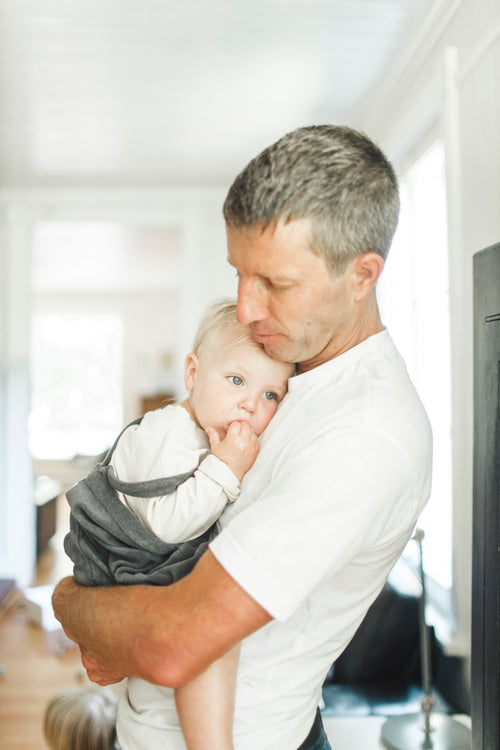
The father's social role and its impact on a child's prenatal and future development
05 June, 2024 • Par Laurence Morency-Guay
There's no denying that today's fathers have a completely different view of their role compared with fathers fifty years ago. Most of them get involved alongside their partner from pregnancy onward (in the case of a heterosexual couple) and take to heart the place they hold in their offspring's lives.
Emotional support
By being involved in the great work of carrying life, a father can offer important emotional support, whether by listening to his partner's symptoms and discomforts in order to offer support, taking an interest in each stage of prenatal development, or taking part in follow-up meetings and appointments. His involvement and support can reduce maternal stress, which is an important influencing factor for both the baby's development and the mother.
Prenatal stimulation
Interacting with the unborn baby by talking, singing or stroking the belly, as well as planning various future family projects, can stimulate the fetus's sensory development and encourage an early bond between the father and the unborn child, knowing that it can sometimes be hard for a father to realize the adventure that awaits him since he doesn't see his body changing and doesn't feel the baby move.
Parental engagement
A father's involvement from the moment the pregnancy is announced helps create a stable, secure family environment for the child, which acts as an important protective factor for their long-term development.
Acting as a role model
Fathers play an essential role as behaviour models for their children. Their behaviour and their interactions with other family members can influence the child's values and attitudes, here meaning the siblings, who can see their father contribute to the family dynamic and invest himself during the pregnancy.
Shared responsibility
A father's involvement in the child's care and upbringing promotes shared parental responsibility, which can reduce the other parent's mental load and strengthen family bonds.
A boost for cognition
Studies show that a father's presence and engagement are associated with better cognitive and social outcomes in children. Children with an involved father tend to perform better at school and to have more developed social skills.
In sum, a father's social role is multidimensional and has a significant impact on a child's prenatal and future development, by contributing to their emotional health, their cognitive and social development, and the creation of a stable, harmonious family environment.
References:
Lamb ME, ed. (2010) The role of the father in child development. New York: John Wiley and Sons.
Shwalb DW, Shwalb BJ, Lamb, ME, eds. (2013) Fathers in cultural context. New York: Routledge.
Marlowe F. (2000). Paternal investment and the human mating system. Behavioural Processes, 51(1):45-61.
McWayne C, Downer JT, Campos R, Harris RD. (2013). Father involvement during early childhood and its association with children's early learning: A meta-analysis. Early Education & Development, 24(6):898-922.

Put these tips into practice
Get the whole family organized with Octave
Meals, chores, the calendar and routines for the whole family in one place: on everyone's phone and on the Station on your wall.
The app is free on iOS and Android.