



Family calendar, board games, cash register… Concrete tools to prepare for the abstract
06 March, 2025
When a child learns to count, manage money or follow a routine, their brain needs a bridge between the real world and invisible concepts. That bridge is the progression from concrete to abstract, an essential teaching method for building solid skills. Here's why this principle should guide all learning, from math to everyday life.
Why does the concrete always come first?
The human brain, especially a child's, is wired to learn through the senses and action. Before handling symbols or complex ideas, it first has to feel, touch and experiment. Here are three examples that illustrate this logic:
1. The value of numbers
-
Concrete: Grouping cubes into tens, trading 10 ones for 1 ten.
-
Abstract: Understanding that the “1” in 214 stands for 10, and the “2” stands for 200.
-
Why it works: Handling the cubes gives place value a tangible meaning, which prevents mistakes like “214 = 2+1+4.”
2. Learning about money
-
Concrete: Paying in cash with coins and bills.
-
Abstract: Using a bank card or managing a digital account.
-
Why it works: Handling real money teaches the idea of exchange and value, long before a child can grasp the concept of a bank balance.
3. Daily routines
-
Concrete: One pictogram per action (for example: bed made → clothes → breakfast).
-
Abstract: A single “morning routine” symbol that stands for a sequence of 5 steps.
-
Why it works: The concrete detail structures memory, then the abstract builds independence and flexibility.
The role of the abstract: generalizing and freeing up thinking
Once the concrete is mastered, the abstract makes it possible to:
-
Transfer skills to new situations (for example, using the same math rules to cook or build things).
-
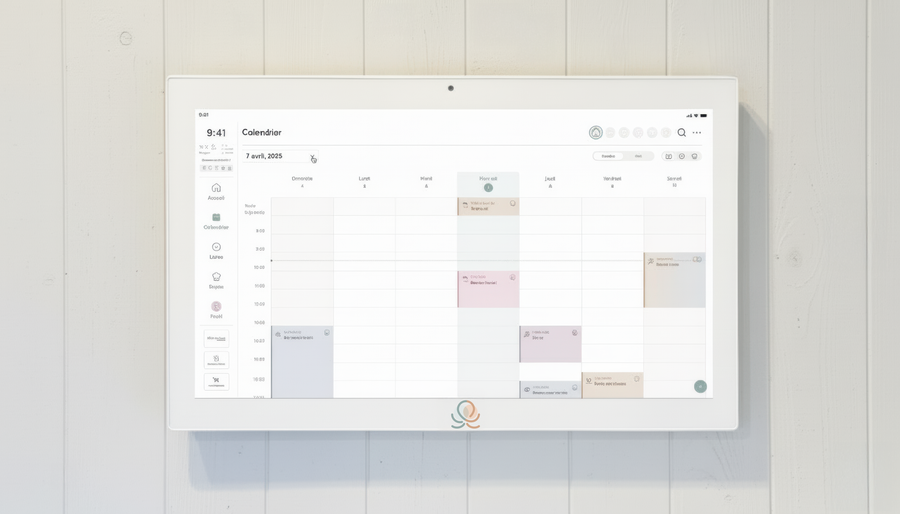
Gain efficiency (for example, moving from a wall calendar to an app like Octave).
-
Spark creativity (for example, making up a story from abstract words like “courage” or “friendship”).
But watch out: Skipping the concrete stage risks creating gaps. A child who has never counted real objects might see fractions or equations as magic formulas… and not as logical tools.
In the digital age, the concrete matters more than ever
Screens and apps (calculators, digital calendars, educational games) are tools that are abstract by nature. For a child to use them wisely, they first need to anchor the concepts in the real world:
-
Before using Octave (abstract task management), kids need to understand time with a physical calendar and magnets.
-
Before playing an educational video game about fractions, a child needs to have shared a pizza with the family.
The trap to avoid: Believing that digital replaces sensory experience. In reality, it complements it… as long as the concrete foundation is solid!
Practical tips for applying this method
-
Play before teaching:
-
Use LEGO for math, role-playing games for money and cooking recipes for measurements.
-
Connect the abstract to everyday life:
-
Show that addition is how you work out the grocery bill, or that conjugated verbs give structure to the sentences in their favourite stories.
-
Respect their pace:
-
Some children need to handle things for a long time before moving on to the abstract. Others pick it up quickly. Adapt!
In short: from the real to the invisible, a necessary journey
Moving from concrete to abstract means retracing the natural path of human learning:
-
I touch, I see, I experiment → I understand.
-
I symbolize, I generalize → I master.
🚀 Find this article and much more in the Octave app: shared calendar, collaborative task list, meal planner, centralized family info and independence tracking – your number one ally for an organized family life! 📱✨
Put these tips into practice
Get the whole family organized with Octave
Meals, chores, the calendar and routines for the whole family in one place: on everyone's phone and on the Station on your wall.
The app is free on iOS and Android.