



Emotional intelligence in children: how to build it day to day
25 May, 2026
We often talk about school grades, academic skills and extracurricular activities as indicators of children's future success, but there's a less visible skill, harder to measure but just as decisive: emotional intelligence. The ability to recognize your own emotions, name them, manage them and understand other people's is one of the most valuable abilities a child can develop, and it isn't learned in a class, but in all the little moments of everyday life!
What is emotional intelligence?
Emotional intelligence is the ability to navigate the inner world, your own and other people's, with awareness and skill. For a child, it concretely translates into several abilities that develop gradually: recognizing what they feel and being able to name it, tolerating uncomfortable emotions without exploding or shutting down completely, understanding that others also have emotions that are different from their own, and regulating their reactions rather than being entirely ruled by them.
These skills aren't innate; they're learned, practised and modelled. And parents are the first and most important teachers in this area.
The vocabulary of emotions
Of course, it's hard to manage what you can't name. So a child who only has access to the words “mad,” “sad” and “happy” to describe their inner world is a bit like someone trying to paint with only three colours. It's therefore important, as a parent, to take the time to enrich your children's emotional vocabulary.
To do this, you can simply name the different emotions they experience out loud in everyday life: “You seem frustrated because it's not working the way you wanted.” “I can see you're disappointed that the day is over.” “You look really proud of what you did.” These reflections don't just validate the emotion, they also teach the child to put words to what they feel, a skill they'll gradually absorb and then be able to use on their own.
Welcoming difficult emotions
The natural reflex of many parents faced with their children's intense emotions, whether meltdowns, tears or anger, is often to want to make them disappear as quickly as possible. “Stop crying, it's not that bad.” “Calm down.” “You have no reason to be mad.” These well-intentioned responses nonetheless send a problematic message: the child's emotions are excessive, undesirable or wrong.
A child who learns that their emotions aren't welcome doesn't stop feeling them; instead, they learn to hide them, bottle them up or even feel ashamed of them. Conversely, a child whose emotions are welcomed calmly and without judgment learns that they can get through them without being overwhelmed, and that's precisely what they need to develop their ability to regulate them.
Modelling your own emotional management
Children learn infinitely more from what they observe than from what they're told. A parent who names their own emotions out loud (“I'm frustrated right now, I'm going to take a minute before I answer”) teaches their child that it's normal to have difficult emotions, and that there are ways to handle them other than exploding or ignoring them.
Of course, this isn't about perfection; a parent who gets angry, loses patience and then acknowledges it (“I overreacted earlier, I'm sorry”) teaches something even more valuable: repair.
Creating opportunities to practise every day
Emotional intelligence develops in the friction of everyday life: squabbles between siblings, disappointments, frustrations, fears. These uncomfortable moments aren't obstacles to emotional education; they're actually a perfect training ground.
Rather than solving all the conflicts for the children, guide them through the process: “How do you think your brother felt when you did that?” “What could you have done differently?” “What could help sort this out?” These questions, asked calmly and without pressure, build empathy, problem-solving and emotional accountability, all fundamental components of emotional intelligence.
A child who grows up with these skills arrives in adulthood with something that school grades don't measure, but that life constantly demands: the ability to know themselves, to regulate themselves and to connect authentically with others. 💙
Put these tips into practice
Get the whole family organized with Octave
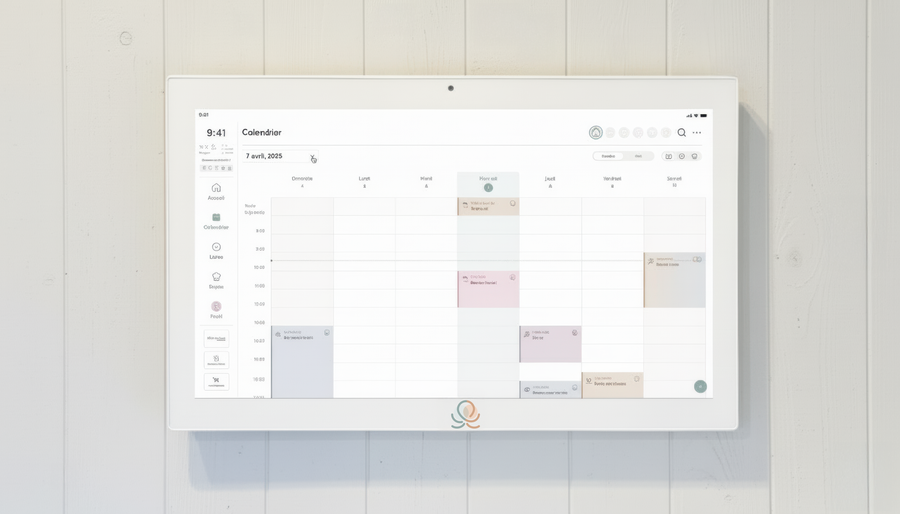
Meals, chores, the calendar and routines for the whole family in one place: on everyone's phone and on the Station on your wall.
The app is free on iOS and Android.